MOTHER Letters ·
Rated Before Issued
A community biochar project in Western India has been graded before issuing a single credit. The grade speaks to likelihood; the tonnes themselves are yet to be made.
The record
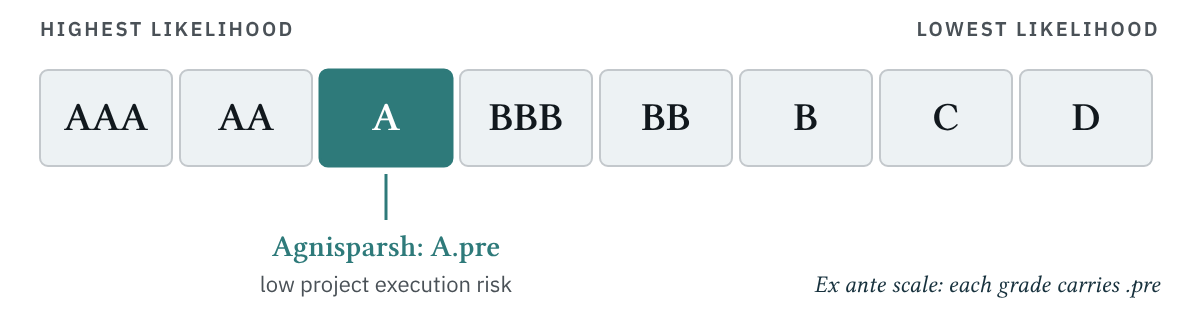
On 13 November, Varaha announced that its Agnisparsh biochar project in Western India carries an ex ante rating of A.pre from BeZero Carbon, assigned in October with low execution risk.1,2 The suffix marks a grade given before issuance; A.pre stands third on an eight-point scale.3
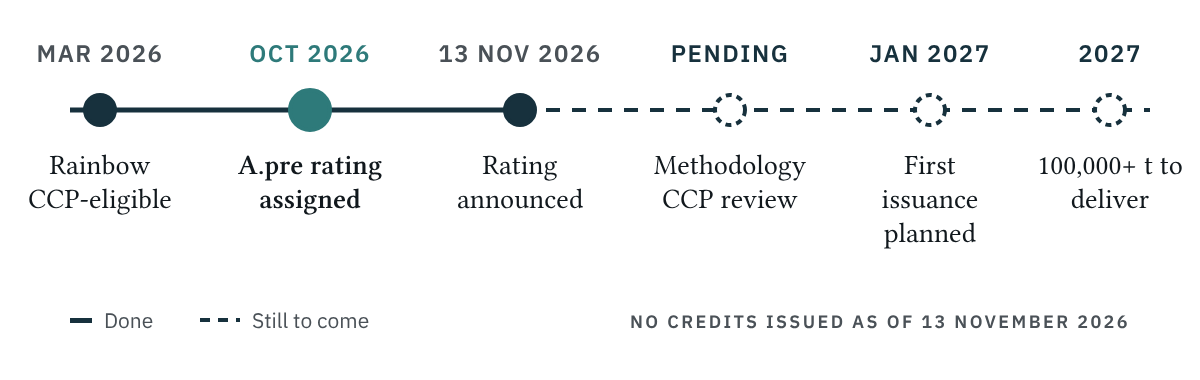
Some 450 Kon-Tiki kilns turn crop residues, otherwise burned after harvest, into biochar returned to farmers without charge. First issuance is planned for January 2027, with more than 100,000 tonnes expected that year.1
Our read
The grade weighs additionality, carbon accounting and permanence before a tonne exists.2 Its value lies in timing: buyers and lenders gain an independent view of delivery risk when finance is committed, before a registry has anything to record.
Its limits deserve equal candour: no credit issued, a methodology still under assessment, no buyer named.1
A grade is a considered opinion about a tonne not yet made. January’s issuance will offer the first evidence against which to read it.
Room for disagreement
Quality in smallholder biochar, dispersed across farms, has long been hard to show. A grade before issuance offers such projects a common measure, and the Rainbow programme was confirmed eligible for the Core Carbon Principles in March.1
What to watch
- January 2027
- First issuance. The first verified credits.1
- Pending
- Methodology review. The assessment of Rainbow’s open-kiln methodology.1
- 2027
- Delivery. Whether volumes approach the 100,000 tonnes expected.1
Also worth your time
The Antalya Statement. Zambia signed the Antalya Statement on Mobilising Private Finance for Climate Action on 12 November and joined the launch of a playbook on high-integrity credits.
Perspectives No. 003. Our essay on the claims gathering around a tonne before issuance.
For the farmers tending these kilns, the work has begun; we will read January’s issuance against the grade that preceded it.
Foster the world that fostered you.
MOTHER Carbon. Fostering Earth.
The Earth raised us. Now it is our turn.
MOTHER takes no view on any country, project or crediting programme named in this letter. This letter reports what the public record discloses and makes no claim about the integrity of any credit.
References
- Varaha, Rainbow and BeZero Carbon (2026). ‘Varaha’s Community-led Biochar Project Achieves a BeZero Carbon ex ante Rating of A.pre’, press release via ANI, 13 November.
- Ranevska, S. (2026). ‘Varaha’s Community-Led Biochar Project Is Now Rated As A.pre Ex Ante By BeZero’, Carbon Herald, 13 November.
- BeZero Carbon (n.d.). ‘How to communicate BeZero’s ratings’, guidance note.