MOTHER Letters ·
Credits Without a Market
Türkiye has spent years developing a supply of voluntary carbon credits. It is now building a domestic emissions market, but whether those credits will find a place within it remains an open question.

The record
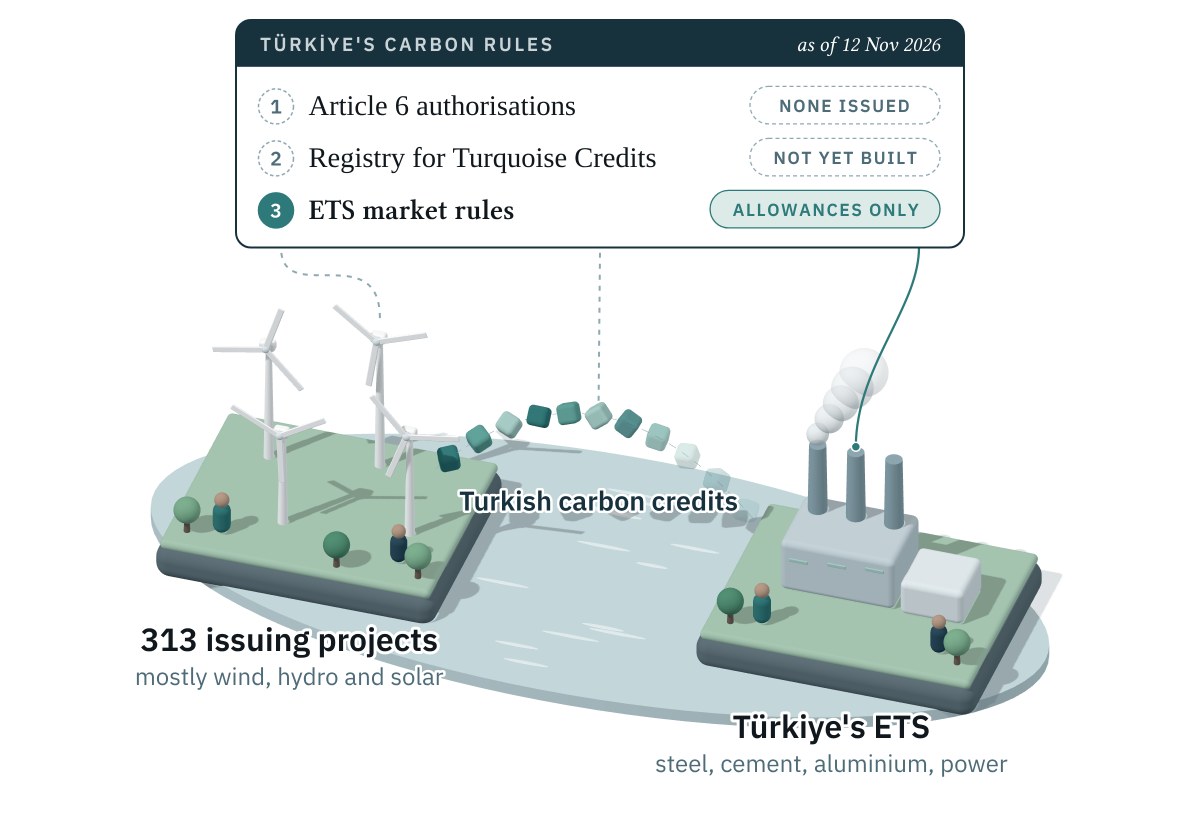
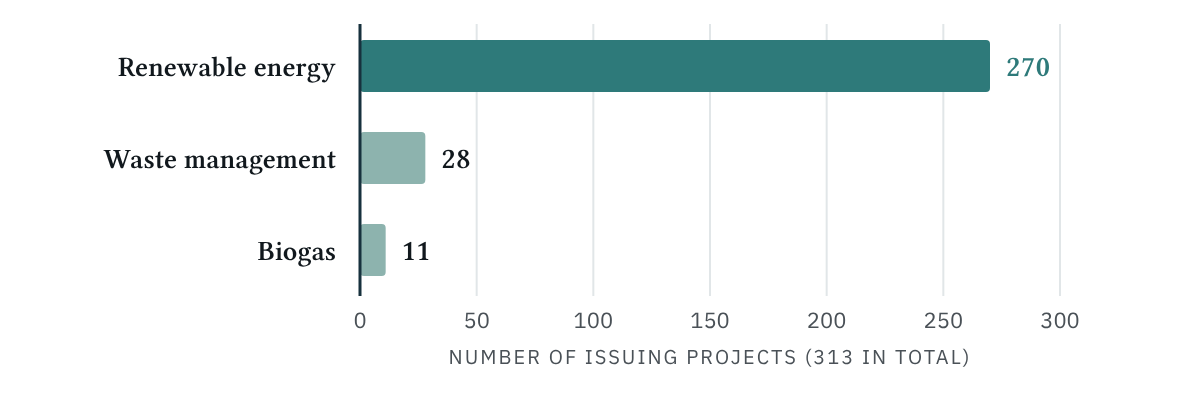
Türkiye enters COP31 with an established, if unevenly developed, carbon credit industry. Its 313 issuing projects are concentrated in renewable energy, which accounts for 270, alongside 28 waste management and 11 biogas projects. During the first nine and a half months of 2026, these projects issued 10.0 million credits, against 17.6 million during the whole of 2025. Registry balances stand at 118.8 million credits, with 82.0 million retired to date.1
This is an industry with a history of issuance and international participation. Yet its relationship with the country's emerging compliance market remains uncertain.
Türkiye has recorded no Article 6.2 agreements, letters of authorisation or corresponding adjustments.1 At the same time, the regulation published in October establishes an emissions trading market under EPİAŞ, built around allowances rather than the voluntary credits already circulating through international registries.2
Our read
The distinction deserves attention because the existence of a carbon credit is not, in itself, a guarantee of its recognition within another market.
Of Türkiye's 313 issuing projects, 270 are in renewable energy. This concentration is consequential. Renewable energy methodologies of the kind represented in existing voluntary supply have not received approval under the ICVCM's Core Carbon Principles framework, narrowing their prospects in a market increasingly attentive to credit quality and additionality.1,7
Meanwhile, the domestic ETS is expected to accommodate nationally issued Turquoise Credits rather than automatically admitting credits from Verra or Gold Standard. The precise rules governing their use, however, have yet to be settled.1,3
There is a coherent policy rationale behind the new market. By establishing a domestic price for industrial emissions, Türkiye may enable qualifying carbon costs paid at home to be recognised under the European Union's Carbon Border Adjustment Mechanism.5
But the question facing existing project developers is different. A national system designed to price industrial emissions does not necessarily create demand for reductions certified under voluntary standards.
Türkiye is giving carbon a domestic price. It has yet to determine what place its existing carbon credits will occupy within that architecture.
Room for disagreement
It would be premature to regard the separation as permanent.
Existing projects are expected to receive an opportunity to register when the national registry becomes operational. Domestic credits may eventually be permitted to satisfy up to 10% of ETS obligations, although the governing rules remain under development.1,3
The pilot's provision for full free allocation also allows the authorities time to establish the market before introducing a more demanding compliance environment.3
Nor has Türkiye abandoned the international dimension of carbon cooperation. Its recently announced initiative with China and Ethiopia suggests that cross-border crediting remains within the scope of its policy ambitions.6
The more reasonable conclusion, therefore, is not that Türkiye's voluntary credit industry has been excluded, but that its future relationship with the domestic market has yet to be defined.
What to watch
- 20 November
- COP31 concludes in Antalya. The closing negotiations may offer further indications of Türkiye's position on international carbon cooperation.6
- Before the first compliance cycle
- Credit eligibility. The Carbon Market Board is expected to clarify the conditions under which credits may be used within the ETS.3
- 2027 to 2028
- Carbon border policy. Türkiye's proposed national carbon border mechanism and supporting emissions-data infrastructure may further shape the relationship between domestic carbon pricing and international trade.4
Also worth your time
Indonesia and Norway. Indonesia's first Article 6.2 purchase agreement with Norway provides a useful contrast: a bilateral route through which authorised mitigation outcomes may be transferred internationally.
Brazil's authorisation ceiling. Brazil's proposed limit of 50 million tonnes of internationally transferred mitigation outcomes through 2030 raises a question of national accounting: how much of a country's mitigation should be made available for use elsewhere?
Türkiye's experience illustrates a wider difficulty in the development of carbon markets. Environmental outcomes may be measured and certified long before the institutions governing their recognition have fully matured.
The question is not simply whether credits exist, but what they represent, where they may be used and under whose authority their claims can be recognised.
For the projects already operating in Türkiye, these distinctions will influence the value and future relevance of years of environmental work. For the country's emerging carbon market, they will help determine whether domestic pricing and international crediting develop as complementary institutions or remain separate systems.
MOTHER will follow that distinction as the rules take shape.

Foster the world that fostered you.
MOTHER Carbon. Fostering Earth.
The Earth raised us. Now it is our turn.
MOTHER takes no view on any country, project or crediting programme named in this letter. This letter reports what the public record discloses and makes no claim about the integrity of any credit.
References
- Sylvera (2026). ‘COP31 Host Country Analysis: Türkiye's Carbon Market Landscape’, 28 October.
- Erdem & Erdem (2026). ‘Regulation on the Operation of the Turkish Emissions Trading System Market Published’, Official Gazette No. 33407, 21 October.
- International Carbon Action Partnership (2026). ‘Türkiye's Carbon Market Board clarifies initial national ETS pilot design’, 8 September.
- Velev, V. (2026). ‘COP31: Turkey To Develop Its Own CBAM As EU Carbon Costs Reshape Trade’, Carbon Herald, 12 November.
- Stankova, T. (2026). ‘Turkey Sets Up Carbon Market To Capture Revenue From EU Trade’, Carbon Herald, 31 August.
- Xinhua (2026). ‘China, Türkiye, Ethiopia launch carbon crediting initiative at COP31’, 12 November.
- ESG Today (2024). ‘ICVCM Rejects Carbon Credits Based on Renewable Energy’, 7 August.
- Purely Energy (2026). ‘EU ETS carbon price’, accessed 3 November.