MOTHER Letters ·
The bus that never ran
A verifier says every tonne is real. UN reviewers say the paperwork does not yet show how.

Switzerland counts the carbon saved by electric buses in Bangkok towards its climate target. A verifier says every tonne is real. UN reviewers say the paperwork does not yet show how.
Every day, electric buses run scheduled public routes across Bangkok. They are operated by Energy Absolute, and each year the carbon dioxide they are calculated to save is sold abroad.
The buyer is the KliK Foundation, which uses the tonnes to meet an obligation under Swiss law. Switzerland then counts them towards its own target under the Paris Agreement.
In September, KliK announced the latest batch, and the announcement was certain. A third party had verified the monitoring report, “confirming that all emission reductions are real”.
The UN had already looked at the same buses, and given a more careful answer.
Two answers
Under Article 6.2 of the Paris Agreement, each country in a trade must report how the trade works, and a team of UN experts checks the report. Of Switzerland’s report on the Bangkok buses, the reviewers wrote that it was “not found to be sufficiently transparent or complete in relation to how the cooperative approach ensures that there is no net increase in global emissions”.
They said the same of how its baseline is set. Thailand’s report, on the same buses, was flagged on the same two points.
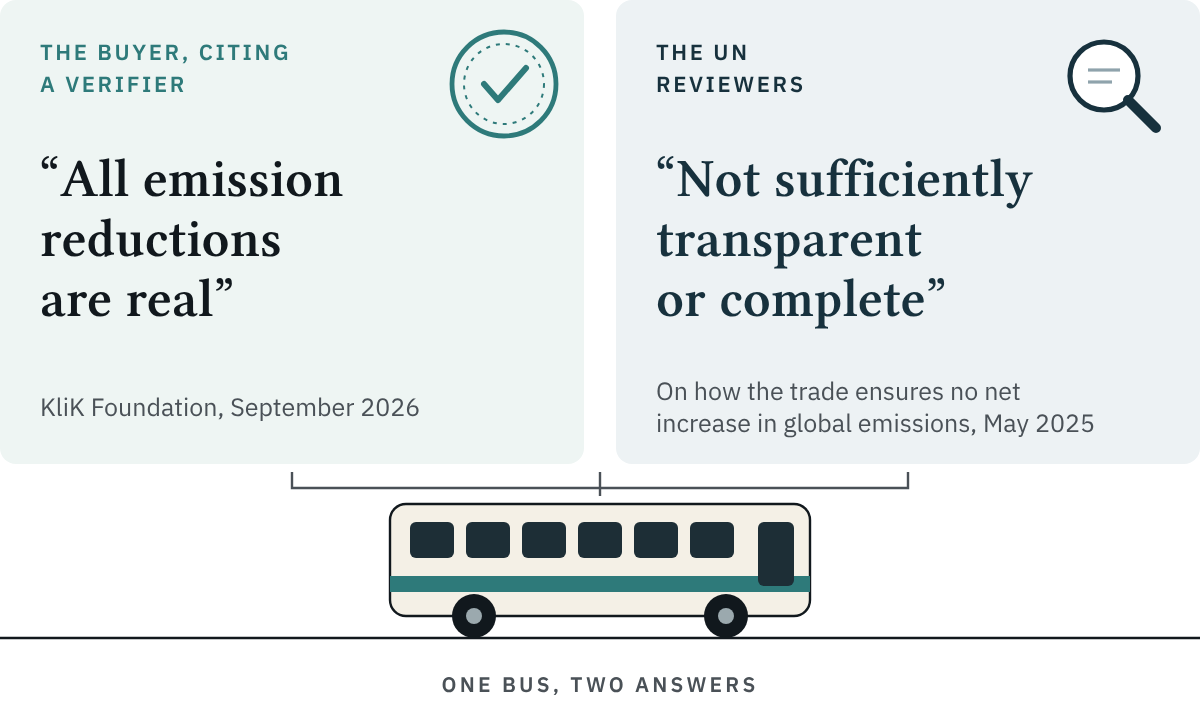
Both may be honest. The verifier checked a monitoring report. The UN checked what Switzerland put on paper. Neither, on its own, tells you how many tonnes the air was spared.
Where the tonnes come from
A tonne saved is the difference between two cities: the one where the electric buses ran, and one where they did not. Nobody can visit the second. It has to be modelled.
In that unseen city, Switzerland told the reviewers, new routes are served by diesel buses and old buses are replaced with more of the same. Some of today’s passengers would have driven instead. Each year a fixed factor of 0.99 is applied to the imagined fleet, because “no country-specific data exist”.
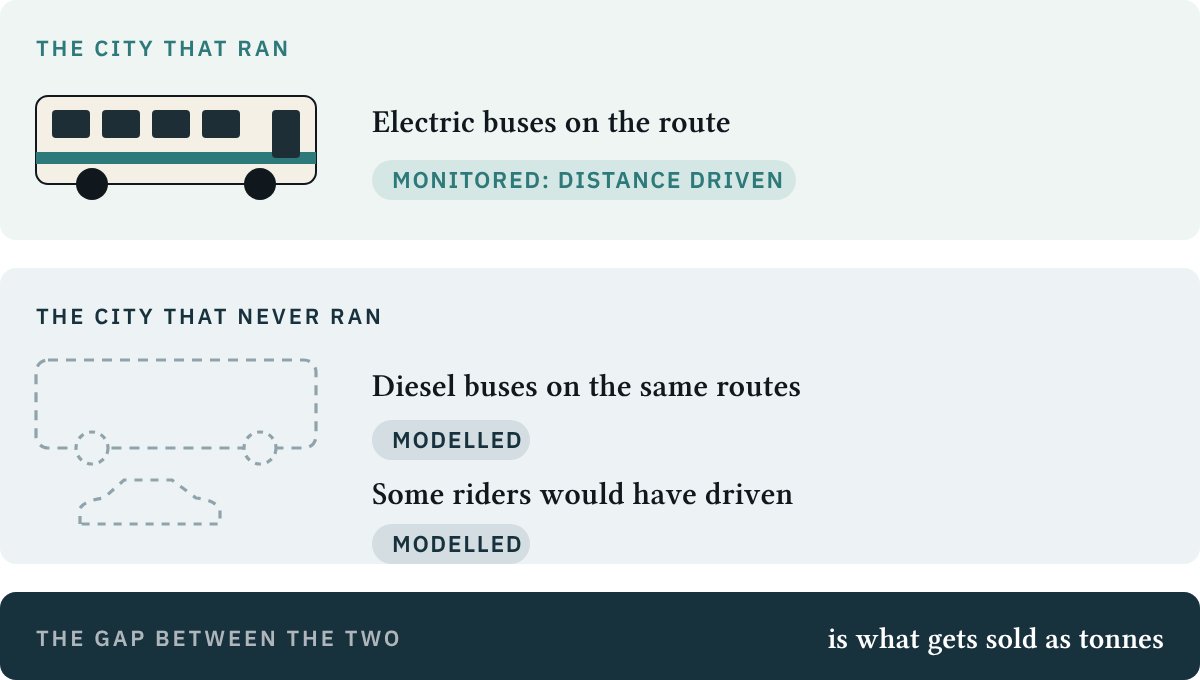
The distance a bus drives can be measured. A bus that never ran cannot.
What happens now
Switzerland welcomed the findings and said it “will update its initial report”. Bangkok is one trade among many. Across all the reviews published so far, the UN counted 543 inconsistencies.
So stand up and ask
Ask what was measured.
Ask what was modelled.
Ask what is still only a promise.
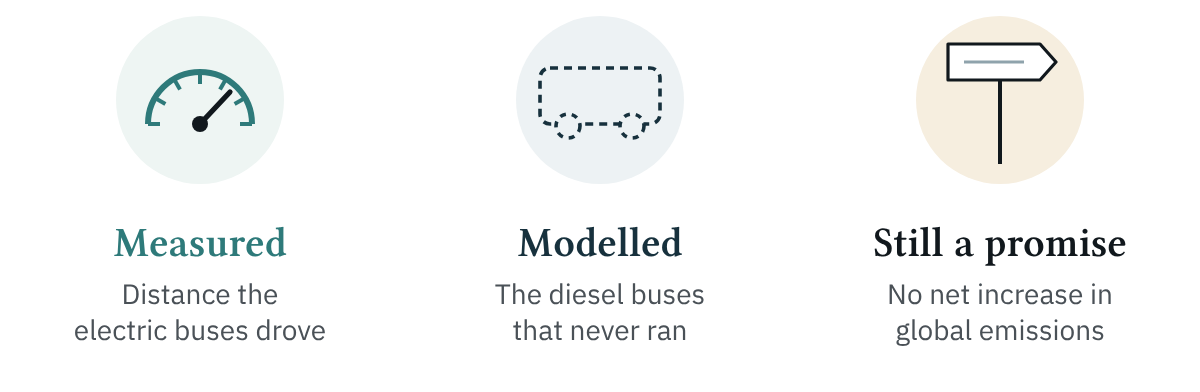
When a government counts a tonne from abroad, ask to see both cities: the one that was measured, and the one that was modelled. Then ask who checked each.
COP31 opens in Antalya on 9 November. It is a good week to ask.
The buses will keep running. The question is whether the working runs with them.

Keep asking with us
MOTHER Insights follows the tonnes from the street to the ledger, and asks what sits behind each one. Subscribe, and bring someone who would ask the same questions.
Foster the world that fostered you.
MOTHER Carbon. Fostering Earth.
The Earth raised us. Now it is our turn.
MOTHER Carbon takes no view on Energy Absolute, the KliK Foundation, Switzerland, Thailand or the programme. The UN findings concern the information reported, not the tonnes themselves. MOTHER Carbon does not provide, arrange or recommend financing.