MOTHER Perspectives · No. 003 ·
The tonne with many owners
AbstractA carbon credit is recorded only after the work is done. The money behind that work now arrives years earlier, through separate contracts on the same future tonnes that no single record shows together.
Keywords pre-issuance finance; offtake; outcome bonds; streaming; security interests; registries; UNIDROIT

Section 1: Finance before issuance
In No. 001 we asked who would build the bridge between a carbon project and the capital it needs before delivery (MOTHER Carbon 2026). In April the World Bank priced a $120 million outcome bond linked to Imperative’s spekboom restoration project (World Bank 2026a). In October Citi closed a $72 million note for Applied Carbon’s biochar project, and HASI lent Terradot $34 million against Frontier offtakes and delivery insurance (Citi 2026; HASI and Terradot 2026).
Projects need this capital. Yet every early payment carries a promise: to deliver, to repay, to share revenue or to make good a shortfall. Each is sound on its own terms. Together they raise a question the market has yet to answer: what has already been promised, and to whom?
The law has begun to answer part of it. UNIDROIT’s draft principles on verified carbon credits treat a credit as existing once it is recorded in a registry, and leave earlier rights to contract and national law (UNIDROIT 2026). The registry record begins at issuance, and the agreements that financed the tonne lie outside it.
Section 2: The nature of claims on an unissued credit
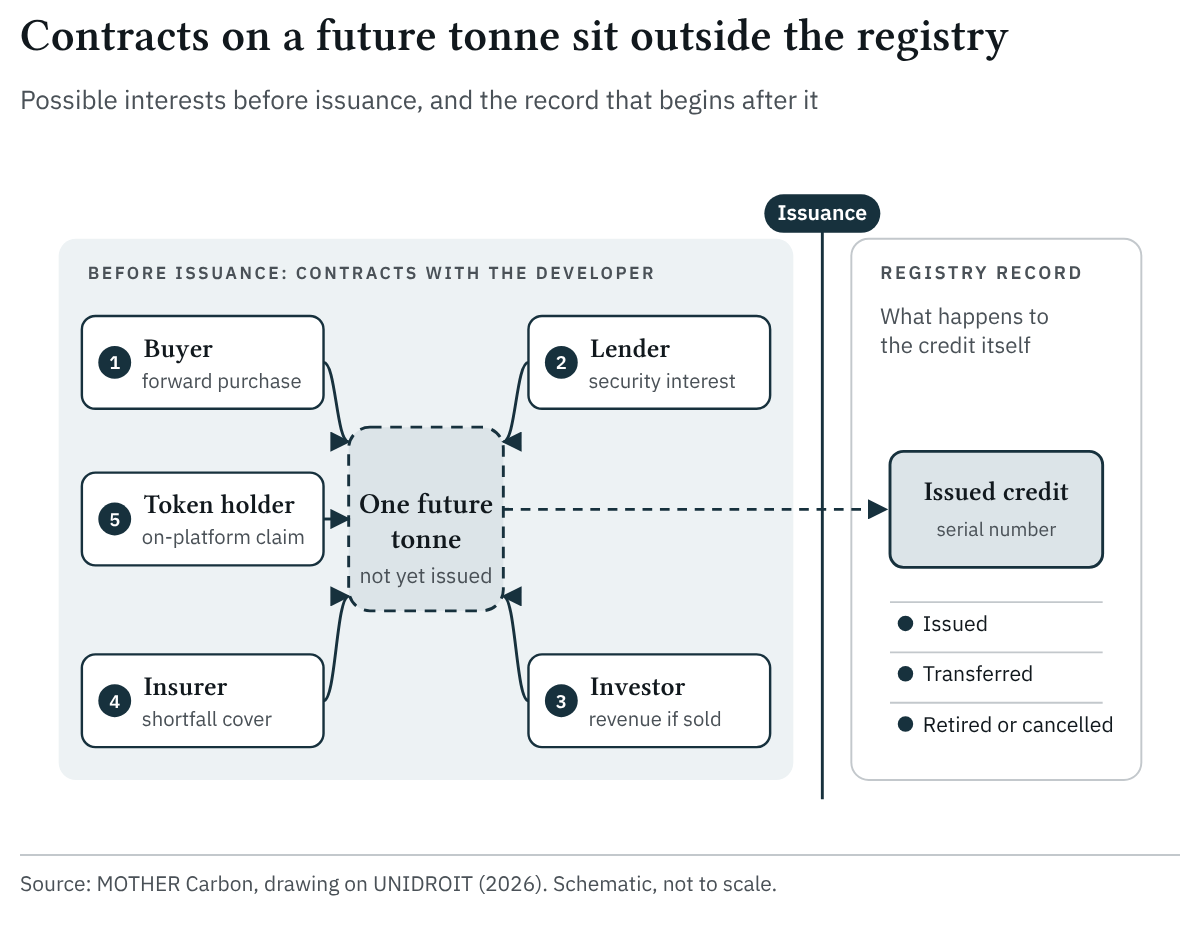
To speak of a tonne with many owners is to use a metaphor. The buyer may be owed delivery; the lender may hold security over the offtake or the project company; the investor may be entitled to revenue once credits are sold. Most are rights against the developer rather than property in a tonne, each governed by its own contract.
The risk is one of arithmetic. Several agreements may look to the same future units and together promise more than the project will deliver. The developer sees every agreement, a later lender usually sees only its own, and the registry sees none.
Delivery data show the scale. CDR.fyi’s June 2026 update put delivery at about 3 per cent of contracted durable removal tonnes, or 13 per cent excluding the long-dated purchases of Microsoft and Frontier (CDR.fyi 2026). Much of that gap is time, but it makes the terms that allocate a shortfall decisive.
Figure 1. Claims that may attach to one future tonne before issuance
Section 3: Precedents from other asset registers
Other markets have learned that a record of an asset need not reveal every interest in it. At Qingdao and Penglai, Dezheng Resources used forged and duplicated warehouse receipts to borrow repeatedly against the same cargoes; its founder was sentenced to 23 years in 2018 (Caixin Global 2018; Global Trade Review 2018). That was fraud; lawful forward finance is a different matter. The narrower lesson is that a document can satisfy one lender while hiding another’s claim.
Carbon has its own example. In March 2010 Hungary lawfully resold two million credits its installations had already surrendered, on condition that they not be used again for compliance in the European Union. Some reappeared on BlueNext in Paris, which suspended trading at once (INTERPOL 2013). Buyers could see the credits on offer, though not that they had been used.
Registration is how other asset classes responded. In the United Kingdom, a company charge not delivered to Companies House within 21 days is void against a liquidator, administrator or creditor (UK Parliament 2006). Under the Cape Town Convention, a registered interest in aircraft takes priority over later and unregistered interests (UNIDROIT 2001). Carbon has registries for credits, but no comparable public record of the claims made before those credits exist.
Figure 2. Four precedents and the lesson each offers for carbon
| Precedent | Lesson for carbon |
|---|---|
| Qingdao | A document accepted by one lender may conceal another lender’s pledge. |
| Hungary, 2010 | A credit’s history must travel with the credit. |
| UK company charges | Filing makes a security interest effective in insolvency. |
| Cape Town Convention | Filing also sets priority between competing interests. |
Section 4: Layered claims in current transactions
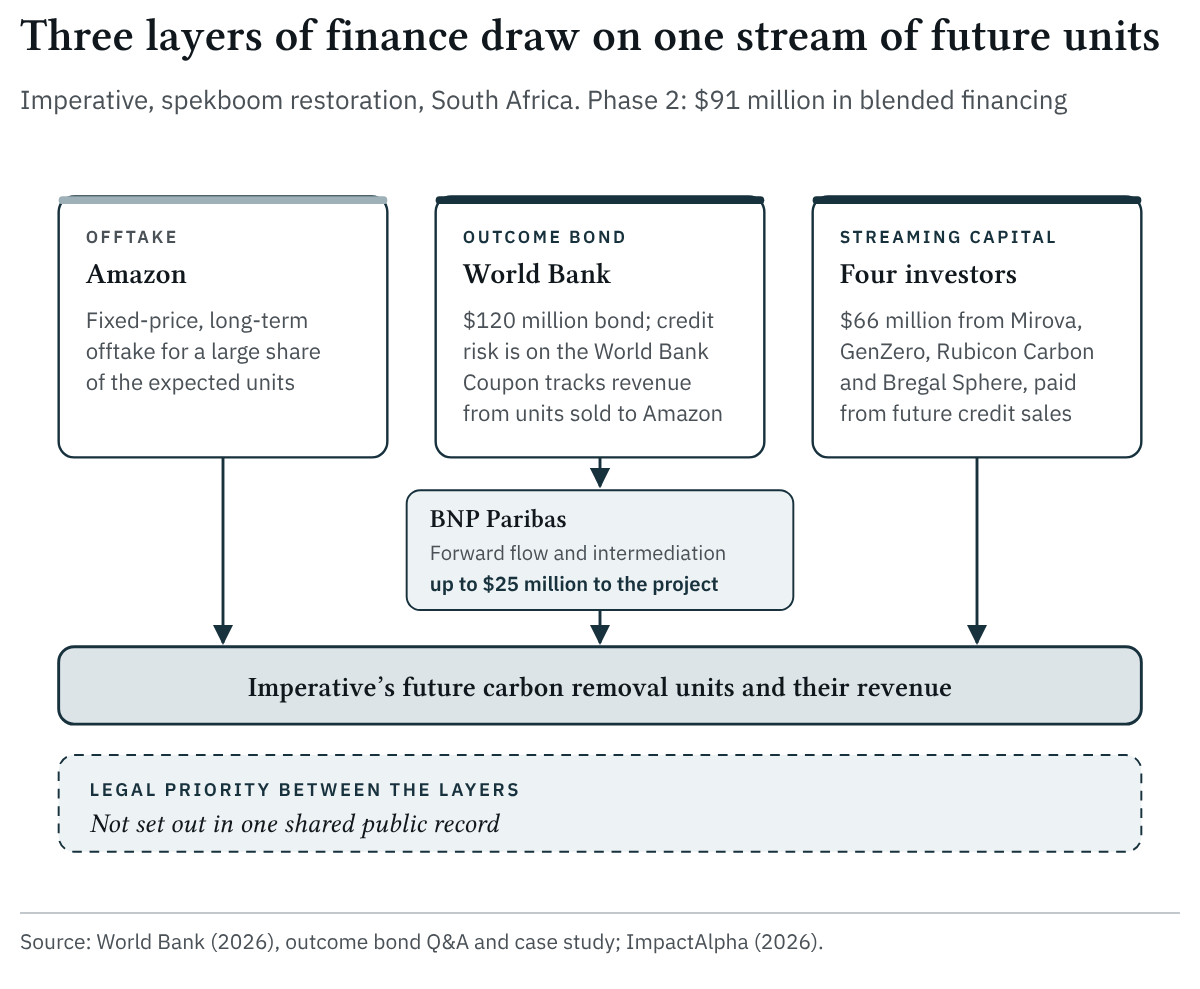
Imperative’s restoration shows how such claims gather around one project. Its second phase closed $91 million: $25 million through the World Bank’s outcome bond and $66 million in streaming capital from Mirova, GenZero, Rubicon Carbon and Bregal Sphere, alongside a long-term Amazon offtake for much of the expected output (ImpactAlpha 2026; World Bank 2026c).
In this structure, bondholders take World Bank credit risk, with part of their return tracking sales to Amazon, while BNP Paribas holds the contract with the project; the streaming investors are repaid from credit sales (ImpactAlpha 2026; World Bank 2026b). The disclosures describe every layer but were not designed to show how the rights rank. That limits what an outsider can see, and implies no conflict between the agreements.
Figure 3. Imperative, Phase 2: three layers of finance on the same future units
Similar structures are spreading. Vaulted Deep’s $35 million Mediobanca facility rests on waste-service agreements and contracted removal revenue, with insurance from Artio (Pulse 2.0 2026). Regenerate Outcomes plans shortfall cover for buyers from a soil-carbon project under validation with Verra (Carbon Herald 2026; AgriInvestor 2026), and Datavault AI and Biochar Now intend to tokenise insured biochar credits (Datavault AI and Biochar Now 2026). None is designed to show the others.
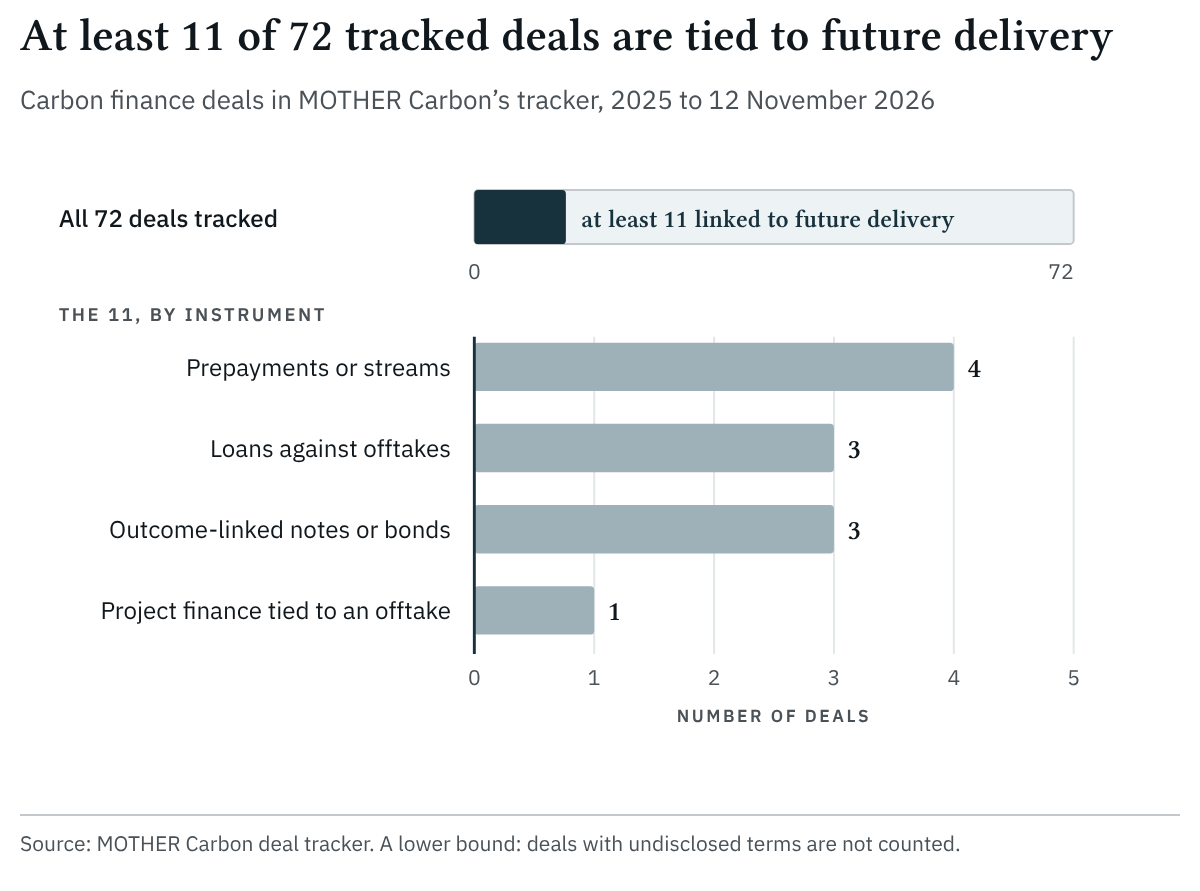
MOTHER Carbon’s tracker counts at least 11 such deals among the 72 it has recorded since 2025.
Figure 4. Delivery-linked transactions among 72 deals tracked since 2025
Section 5: Towards a register of claims before issuance
Within one transaction much of this is settled: lenders take security over offtakes and project shares, obtain consents and agree intercreditor terms. The gap lies between transactions. Forward sales and streams are not security interests, are seldom registrable and are linked to nothing in the crediting registry.
A register would carry costs, so it should be modest: the project, the vintage and the nature of each interest, with prices and terms kept private. Without serial numbers before issuance, it would index notices by project, closer to a charges register than to an asset registry. Who runs it, and which law governs a filing, remain open.
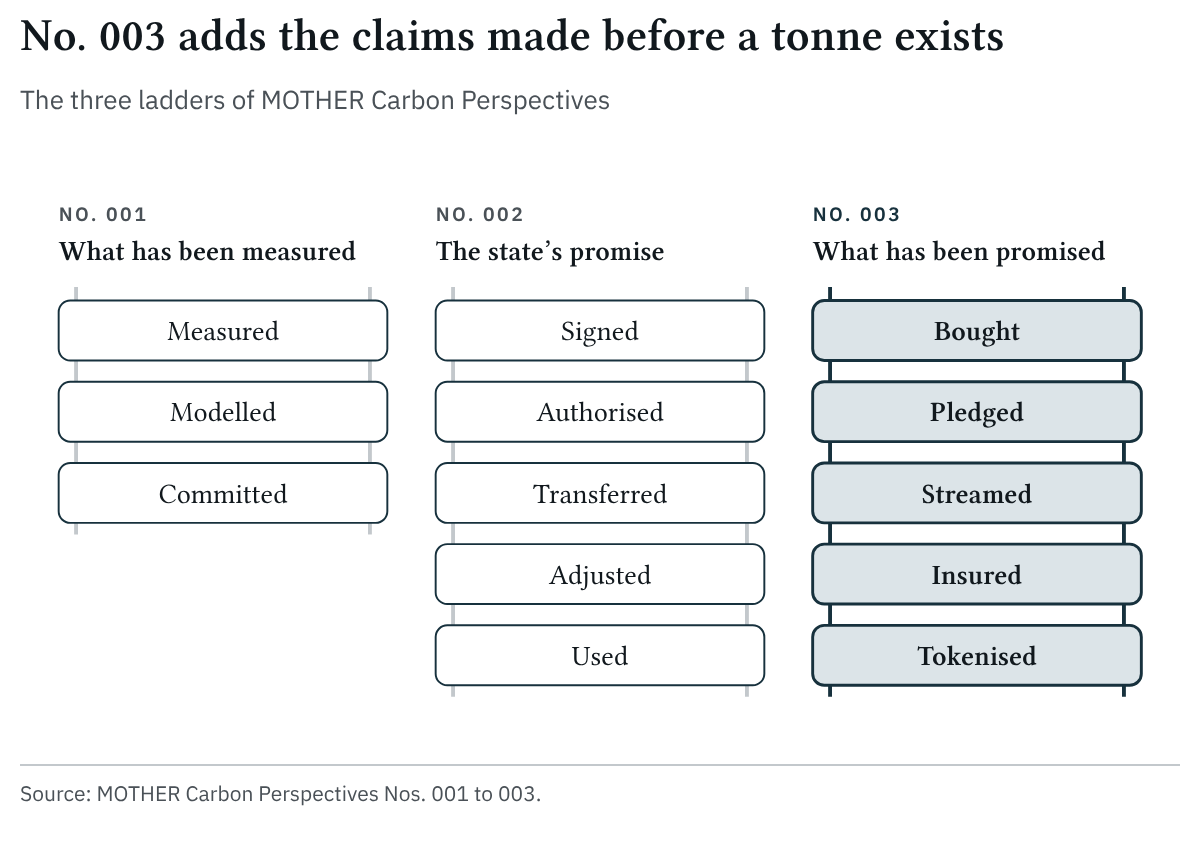
Keyed to the project’s registry identifier, such a register could record offtakes, security interests, streams, notes, insurance and tokens in defined categories. UNIDROIT’s draft already covers registries and secured transactions for issued credits (UNIDROIT 2026); extending that work to interests formed before issuance would let each party discover the claims that precede its own.
Figure 5. The three Perspectives ladders
Anyone relying on a future tonne faces the same questions. Who else has contracted to buy it? Who holds security over the project or its revenue? Who has paid in advance for its credits? What does the insurance cover, and what rights pass to the insurer once it pays? If delivery halves, who is paid first, and where is that written?
As forward finance grows, lenders may come to ask for such a record before they lend. It would give the promises made about future tonnes the visibility that registries already give to the tonnes themselves.
MOTHER Carbon. Fostering Earth.
A venture of aeons labs.
MOTHER Carbon does not provide, arrange or recommend financing, and takes no investment or credit view on the companies, projects or governments discussed.
References
- AgriInvestor (2026). Regenerate Outcomes reaches Verra validation and targets $90 per credit. 18 May.
- Caixin Global (2018). Update: Dezheng founder gets 23 years in prison. 12 December.
- Carbon Herald (2026). Regenerate Outcomes to protect buyers with insurance in case of a carbon credit supply shortfall. November.
- CDR.fyi (2026). Durable CDR market update: from ambition to execution. 12 June.
- Citi (2026). Citi closes $72 million carbon removal-linked note to support Applied Carbon biochar project. Press release, 20 October.
- Datavault AI and Biochar Now (2026). Datavault AI and Biochar Now combine insured carbon removal credits with patented tokenization technology. Business Wire release, republished by Finviz, 9 November.
- Global Trade Review (2018). Qingdao fraud probe ends with jail term. December.
- HASI and Terradot (2026). Terradot and HASI close $34M investment for carbon removal projects. Press release, republished by Finviz, 27 October.
- ImpactAlpha (2026). Outcomes and offtakes spur a 250,000-acre restoration project in South Africa. 28 April.
- INTERPOL (2013). Guide to carbon trading crime. INTERPOL Environmental Crime Programme, p. 15.
- MOTHER Carbon (2026). Perspectives No. 001: The missing bridge: ex post crediting and the pre-issuance financing gap in carbon markets. 6 November.
- Pulse 2.0 (2026). Vaulted Deep secures $35 million in debt financing from Mediobanca, arranged by CFP Energy. 22 September.
- UK Parliament (2006). Companies Act 2006, c. 46, Part 25, ss. 859A and 859H.
- UNIDROIT (2001). Convention on International Interests in Mobile Equipment (Cape Town Convention), Article 29.
- UNIDROIT (2026). Draft UNIDROIT Principles on the Legal Nature of Verified Carbon Credits. Consultation draft, Study LXXXVI. July.
- World Bank (2026a). World Bank prices 14-year Spekboom Restoration Outcome Bond in South Africa. Press release, 23 April.
- World Bank (2026b). Spekboom Restoration Outcome Bond: questions and answers. World Bank Treasury, April.
- World Bank (2026c). World Bank outcome bond helps support ecosystem restoration in South Africa. Case study, World Bank Treasury, 30 April.