MOTHER Perspectives · No. 002 ·
The Sovereign Promise
AbstractThe carbon market has spent a decade learning to establish whether a tonne is real. Article 6 introduces another question, less visible but no less consequential: will the state honour its promise about that tonne?
Keywords Article 6; authorisation; corresponding adjustment; sovereign risk; CORSIA; COP31

Section 1: Introduction
In Antalya, where COP31 is under way, the COP31 Presidency has said that carbon markets should help mobilise more than $50 billion a year in additional finance for developing economies. Yet the infrastructure required to administer Article 6.2 faces a funding shortfall estimated at $8 million to $9 million (Abatable 2026). The contrast is instructive. A market of considerable ambition is still assembling the institutions upon which its promises depend.
For years, the central concern was environmental integrity. Was the reduction additional, measurable and durable? Standards, independent ratings and the Core Carbon Principles have helped bring discipline to that question. In The Missing Bridge, we examined how integrity and delivery risk shape the financing of a tonne before it exists (MOTHER Carbon 2026).
Article 6 adds a second question. An internationally transferred mitigation outcome depends not only upon the quality of the underlying reduction, but upon a government’s authorisation and its subsequent accounting.
The tonne may be sound. The sovereign promise surrounding it may be less certain.
Section 2: The Article 6.2 framework
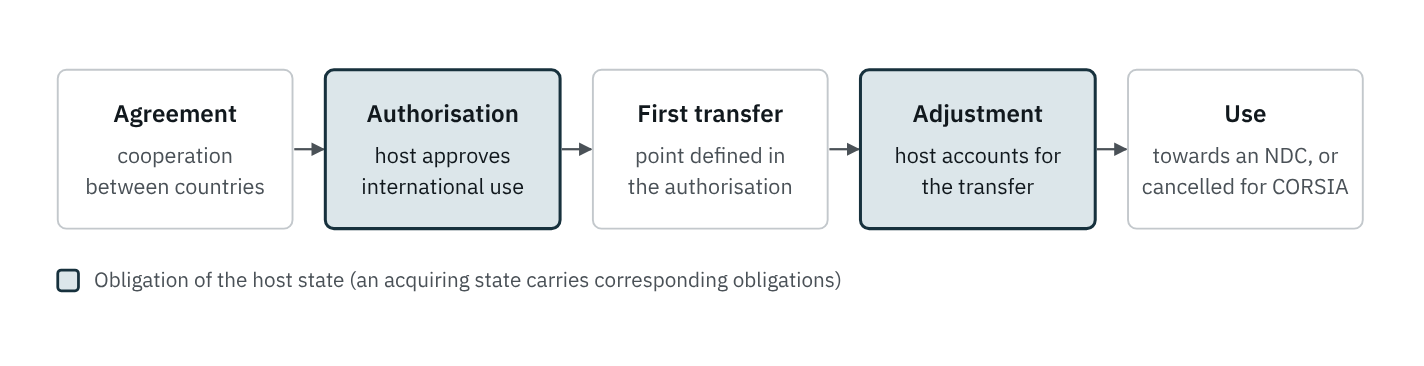
Under Article 6.2, an international transfer rests on five elements: cooperation between countries, authorisation by the host, first transfer, corresponding adjustment and eventual use. They are not always encountered in that order. The point of first transfer is set by the host’s authorisation, and for units authorised for other international purposes, such as CORSIA, it may be the authorisation, the issuance or the use of the unit. The adjustment prevents the same mitigation outcome from being counted twice, whether by two countries towards their climate commitments or by a country and an airline (UNFCCC 2025; Figure 1).
Two obligations are particularly consequential. The host must authorise the outcome for international use and subsequently account for that transfer. Neither obligation is an inherent property of the tonne itself. The same obligation follows any unit the host authorises, whether it is traded bilaterally, issued under the Paris Agreement Crediting Mechanism or certified by an independent standard. Units issued without authorisation carry no adjustment and cannot be counted towards another country’s commitment.
A government may later face stronger domestic emissions, a more demanding nationally determined contribution (NDC), or a change in political priorities. Mitigation once intended for export may become more valuable at home.
There is a limited resemblance to sovereign borrowing: the state commits to a future accounting act upon which others rely, while retaining responsibility for its own climate commitments. The resemblance is limited because the obligation is an entry in a national inventory rather than a payment, and it carries neither a rating nor a creditor’s remedy.
Methodologies can test the reduction. Registries can record its movement. Neither, alone, can ensure that a sovereign accounting obligation will ultimately be fulfilled.
Figure 1. Elements of an Article 6.2 transfer
Simplified sequence
Section 3: Historical precedents
The vulnerability is not merely theoretical. Carbon markets have encountered several forms of sovereign and regulatory uncertainty, each with consequences for those who relied upon earlier arrangements (Figure 2).
Figure 2. Episodes of sovereign and regulatory change, 2008 to 2025
Approximate duration, with COP31 marked
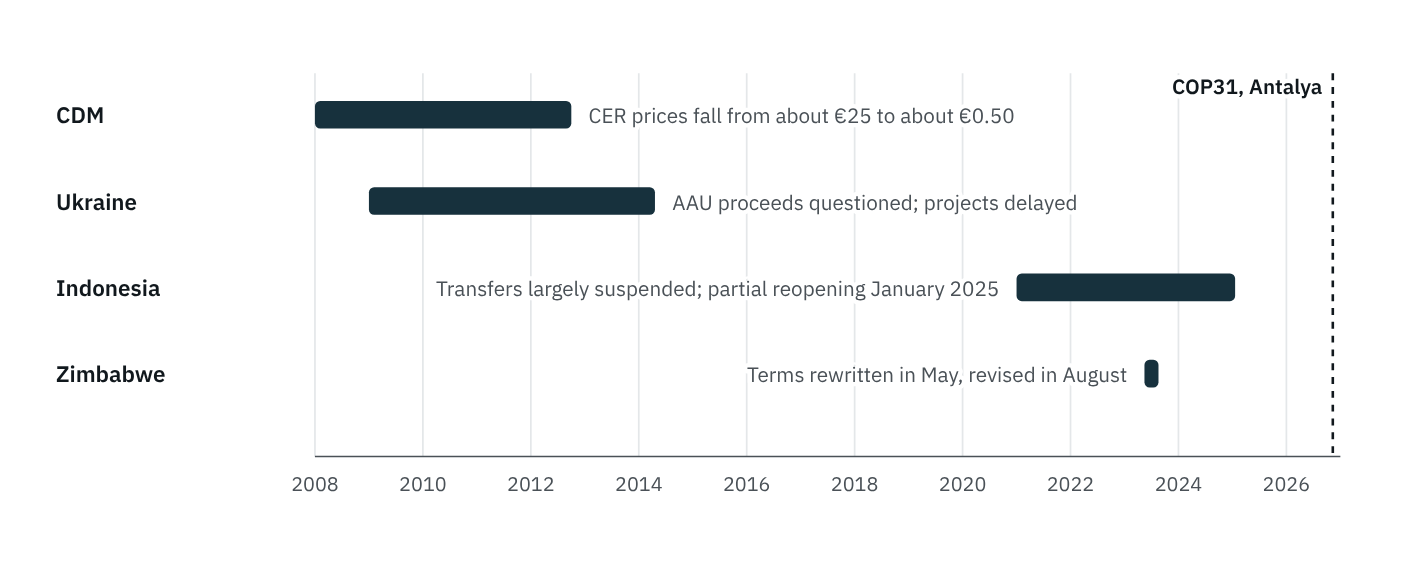
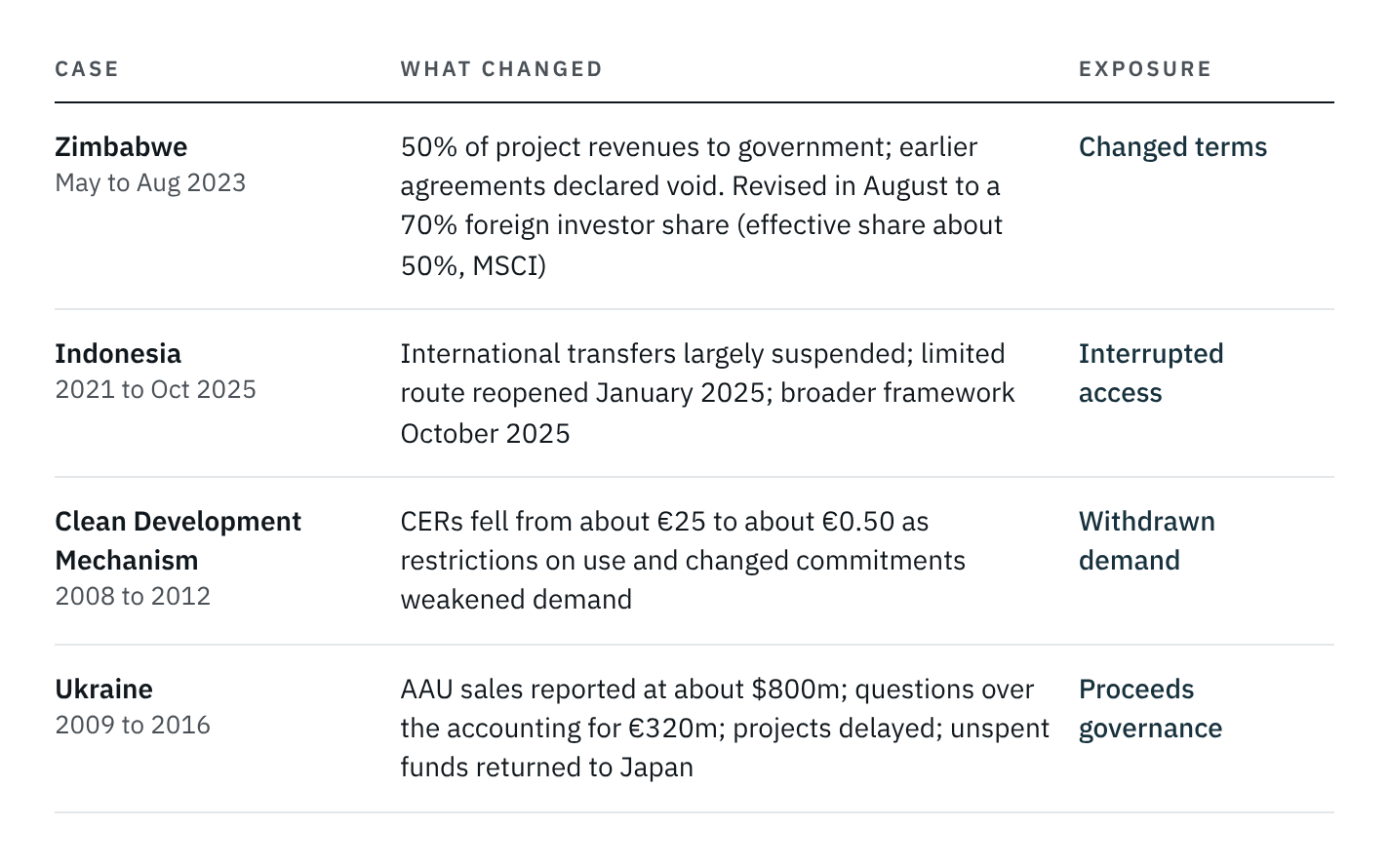
Zimbabwe: the rewriting of terms. In May 2023, Zimbabwe announced a framework allocating 50% of carbon project revenues to the government and, by official account, declaring earlier agreements void. By August, the position had changed, with foreign investors permitted a 70% share, although MSCI estimated their effective share at approximately 50% (S&P Global 2023; MSCI 2023). The changes concerned voluntary market projects rather than Article 6 authorisations. The difficulty was not simply the proposed distribution of revenues. It was the uncertainty created when established commercial expectations were reopened.
Indonesia: the interruption of trade. Regulatory changes beginning in 2021, intended to bring carbon trading under national control and to protect Indonesia’s NDC, largely suspended the international transfer of credits. A limited international route opened on IDXCarbon in January 2025, and a broader framework for international trade followed in October 2025 (OJK 2025; The Jakarta Post 2025). Projects dependent upon overseas buyers faced years in which an anticipated route to market was unavailable, even though the pause reflected a legitimate wish to secure national accounting first. Indonesia’s renewed international engagement at COP31 makes the episode particularly relevant (GGGI 2026): market access can return, but the interruption remains part of its history.
The Clean Development Mechanism: the retreat of demand. Certified Emission Reductions reached approximately €25 in 2008 before falling towards €0.50 in 2012, as restrictions on their use and changing commitments weakened demand. By 2012, around 6,600 projects had been registered under a mechanism that had issued approximately 1.2 billion credits (ANU Crawford School n.d.). Here the decisive change came principally from the buying side. A recognised credit could remain valid while its principal market disappeared, a reminder that the rules of a compliance buyer, CORSIA among them, can reprice authorised units as abruptly as any host government.
Ukraine: the stewardship of proceeds. Ukraine sold Kyoto Assigned Amount Units to international counterparties in transactions reported at approximately $800 million, on the understanding that the proceeds would fund environmental projects. Subsequent reporting raised questions about the accounting for €320 million, intended projects were delayed, and unspent funds were later returned to Japan (Climate Action Network 2010; The Japan Times 2014; Kyiv Post 2016). The units changed hands; the exposure lay in the governance of the revenues received against them.
These histories are not identical, nor do they establish that Article 6 authorisations will suffer the same outcomes. They show, however, that environmental performance and the reliability of the institutions surrounding it are separate matters (Figure 3).
Figure 3. Historical precedents and the exposures they reveal
Case, period and exposure
Section 4: The Guyana arrangement
Guyana offers a more constructive example.
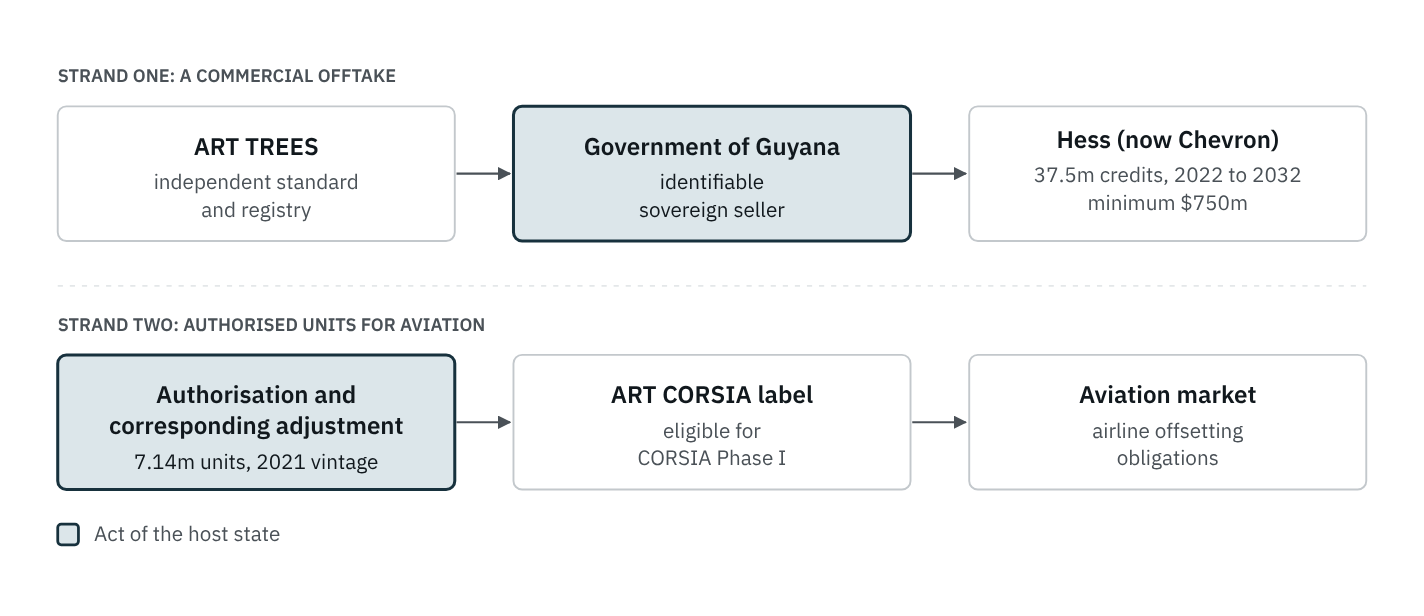
In December 2022, Hess, since acquired by Chevron and a partner in Guyana’s offshore oil production, agreed to purchase 37.5 million jurisdictional forest credits from the Government of Guyana between 2022 and 2032, with a minimum commitment of $750 million (Hess Corporation 2022). The credits are issued under the independent ART TREES standard. Separately, Guyana authorised 7.14 million credits of the 2021 vintage and applied a corresponding adjustment, and ART labelled those units eligible for the first phase of CORSIA (Stabroek News 2024).
The arrangement combined an identifiable sovereign seller, independent certification, a long-term commercial commitment and a recognised route to use (Figure 4). The commercial offtake and the authorised units are distinct strands, and each carries its own evidence.
Figure 4. Structure of the Guyana arrangement
Commercial offtake and authorised units
None of these features eliminates political or accounting risk, and the programme has attracted scrutiny over its accounting and the inclusion of Indigenous communities (Mongabay 2023). Nevertheless, the arrangement demonstrates how obligations can be made more intelligible before buyers commit.
Confidence need not rest upon assurances alone. It can be supported by structure.
Section 5: Market activity at COP31
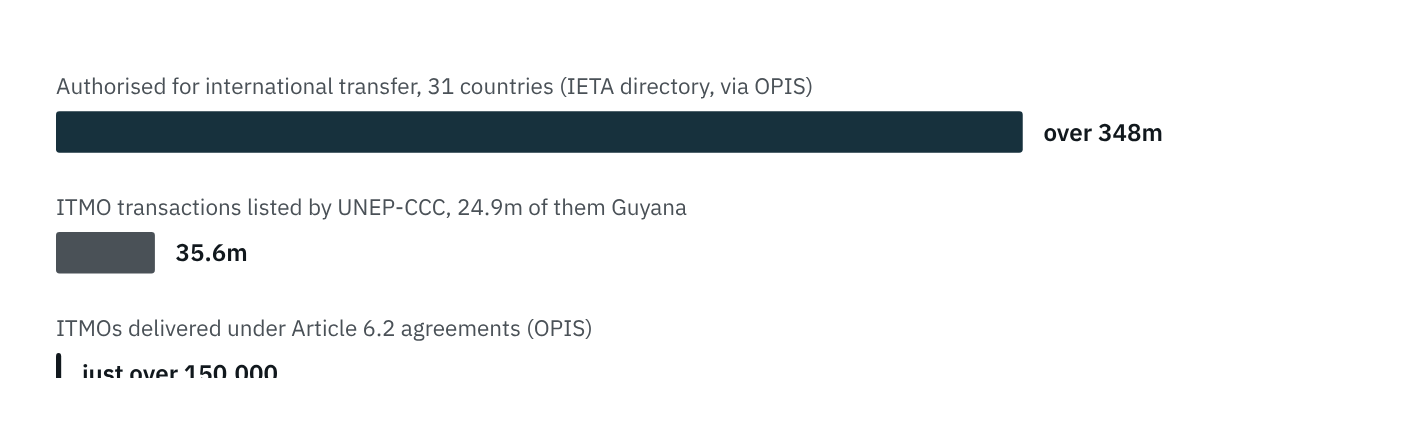
The scale of international commitments is now expanding more quickly than the publicly reported evidence of completed transfers, although how wide that gap appears depends upon what is counted.
As of 5 November, UNEP-CCC recorded 112 bilateral Article 6 agreements involving 65 countries and listed 35.6 million ITMO transactions, including 24.9 million associated with Guyana (UNEP-CCC 2026). Drawing on the IETA Article 6 Project Directory, OPIS reported that 31 countries had authorised more than 348 million credits for international transfer, and that just over 150,000 ITMOs had been delivered under Article 6.2 agreements (OPIS 2026).
These are three different measures, of different scope, and they cannot responsibly be treated as interchangeable measures of completed, adjusted transfers (Figure 5).
Figure 5. Reported measures of Article 6 activity
Credits and ITMOs, as reported in November 2026
The weeks around Antalya have brought further commitments. Indonesia and Norway announced a purchase agreement without disclosing a volume or price. Gabon has agreed to sell approximately six million forest credits to SEFE, with delivery expected by early 2027. Brazil has set ceilings on future international authorisations (GGGI 2026; Carbon Credits 2026; Fastmarkets 2026).
These developments occupy different stages of the market. An agreement is not an authorisation; an authorisation is not a transfer; a transfer is not necessarily evidence of a completed corresponding adjustment.
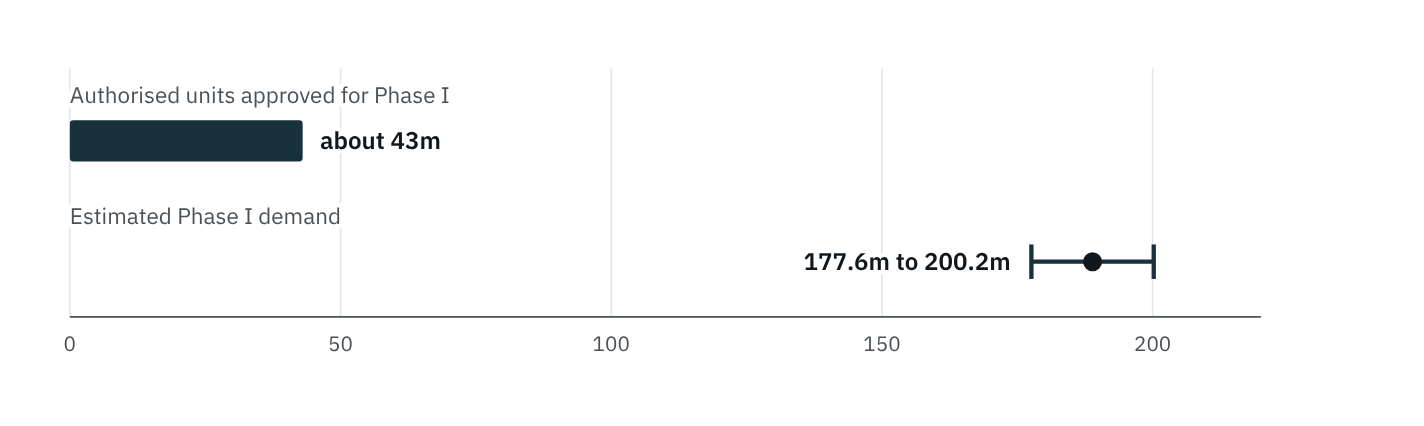
Demand introduces another pressure. Estimated CORSIA Phase I requirements of 177.6 million to 200.2 million units stand against approximately 43 million authorised units approved for that phase, according to figures reported by OPIS (OPIS 2026; Figure 6). Approval, availability and eventual delivery remain distinct.
Figure 6. CORSIA First Phase: estimated demand and authorised supply of eligible units
Million units
Section 6: Revision of authorisations
Governments must retain the capacity to revise policy. Climate commitments evolve, national circumstances change, and a host country may reasonably wish to preserve mitigation for its own population.
The Parties have begun to frame that discretion. Guidance agreed in Baku in 2024 provides that any change to an authorisation shall not apply to, or affect, mitigation outcomes already first transferred, unless the participating Parties have specified otherwise in the terms of the authorisation, and that those terms should set out the circumstances for change and the process for managing it (UNFCCC 2024). What the rules do not supply is enforcement. If a host does not apply an adjustment it has promised, review can record the inconsistency, but a buyer’s remedy lies in contracts, programme rules and insurance rather than in the multilateral process.
The purpose of assessing sovereign risk is not to deny that discretion. It is to establish, before others rely upon a commitment, the circumstances in which its terms may change and the remedies available.
Nor should additional scrutiny become an unnecessary obstacle to climate finance. Uncertainty already imposes costs upon developers and host countries. Clearer commitments may reduce those costs.
Protection against a missing adjustment already exists in several layers. CORSIA expects eligible programmes to have procedures to compensate for, replace or otherwise reconcile mitigation that has been claimed twice (HFW 2024). Purchase agreements may carry warranties and replacement provisions. Insurance against certain political and corresponding-adjustment risks is offered by specialist providers, among them Kita, and MIGA has announced guarantee work for carbon markets (MIGA 2024; Kita n.d.). Such protection is valuable, but it prices and transfers the risk rather than removing it, and it cannot replace transparent rules and credible public accounting.
Section 7: Conclusion
Sovereign authorisations deserve an assessment as disciplined as the scrutiny applied to the underlying carbon reduction.
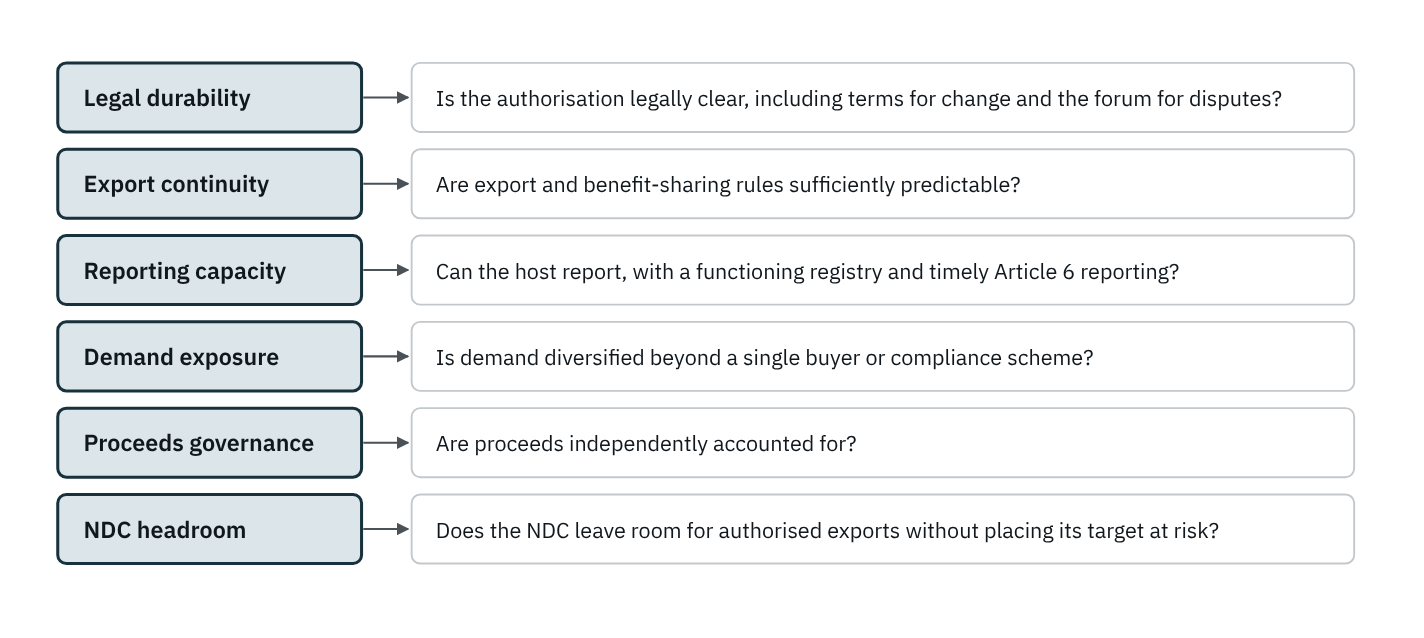
Six questions provide a beginning (Figure 7). Is the authorisation legally clear, including the terms on which it may be changed and the forum for disputes? Are export and benefit-sharing rules sufficiently predictable? Has the host shown that it can report, with a functioning registry and timely Article 6 reporting? Is demand diversified beyond a single buyer or compliance scheme? Are proceeds independently accounted for? And does the host’s NDC, distinguishing conditional from unconditional targets, leave room for authorised exports without placing its own target at risk?
Figure 7. Criteria for assessing a sovereign authorisation
Six criteria
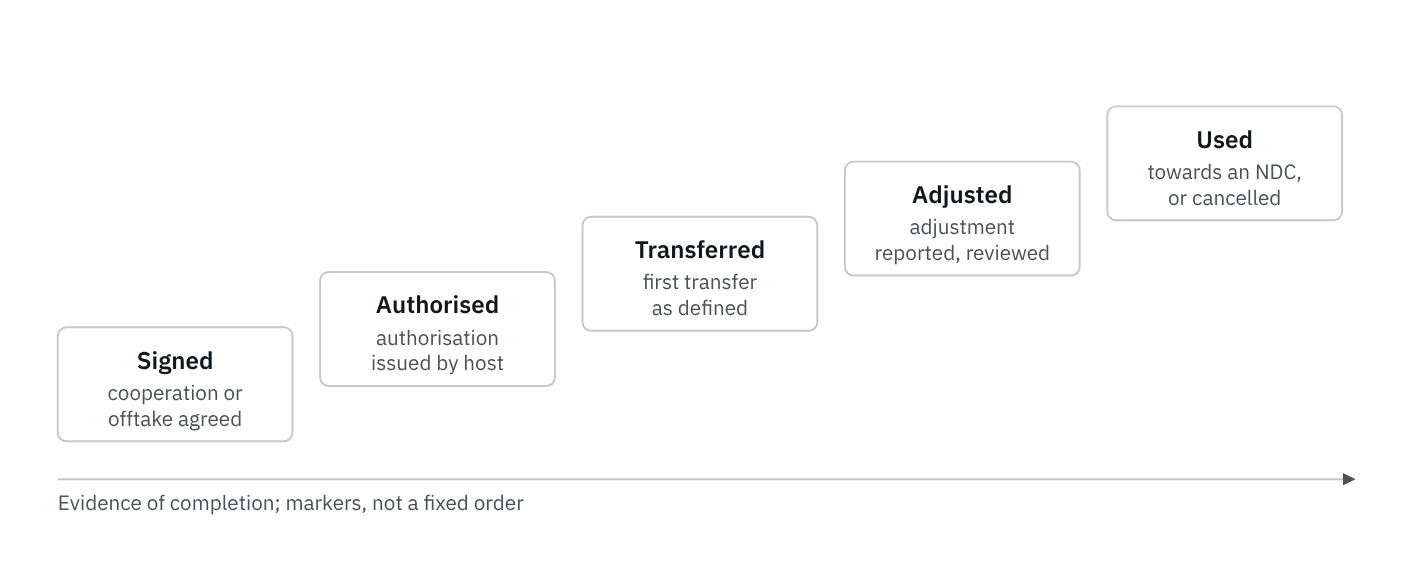
A complementary disclosure framework would distinguish five markers: Signed, Authorised, Transferred, Adjusted and Used (Figure 8). Each conveys a different degree of completion, and each should be supported by evidence appropriate to its claim. They are markers of evidence rather than a fixed sequence: where a host defines first transfer as issuance, as is common for units authorised for CORSIA, an airline may use a unit before the corresponding adjustment for it has been reported, and that adjustment is confirmed only through the host’s later reporting and its review.
Figure 8. Disclosure markers for Article 6 transfers
Evidence of completion
Over time, it is reasonable to expect markets to distinguish governments whose commitments are consistently documented from those whose terms remain uncertain. Whether that distinction commands a measurable price premium remains to be established.
With the next biennial transparency reports due on 31 December 2026, the immediate questions are practical (Abatable 2026). Which outcomes have been authorised? Which have moved? Which corresponding adjustments are evidenced? And what remains dependent upon a future sovereign act?
The integrity of the tonne remains indispensable. So, increasingly, does the integrity of the promise made around it.
MOTHER Carbon. Fostering Earth.
A venture of aeons labs.
MOTHER Carbon does not provide, arrange or recommend financing, and takes no investment or credit view on the companies, projects or governments discussed.
References
- Abatable (2026). COP31 in Antalya: what to expect for carbon markets. 27 October.
- ANU Crawford School (n.d.). Collapse of the CDM scheme under the Kyoto Protocol and its spillover.
- Carbon Credits (2026). Gabon sells 6 million forest carbon credits to SEFE. November.
- Climate Action Network (2010). Ukraine’s AAU black hole. 8 June.
- Fastmarkets (2026). Brazil, Argentina and Chile advance Article 6 plans. November.
- GGGI (2026). Indonesia accelerates energy transition with landmark carbon market agreement at COP31. November.
- Hess Corporation (2022). Hess Corporation and the Government of Guyana announce REDD+ carbon credits purchase agreement. 2 December.
- HFW (2024). CORSIA eligible emission units and an airline’s offsetting obligations. 1 July.
- Kita (n.d.). Political risk insurance.
- Kyiv Post (2016). Ukraine returns 2.5 million euros in unspent green investments to Japan. 1 March.
- MIGA (2024). Deploying World Bank Group Guarantee Platform to de-risk carbon markets. 14 November.
- Mongabay (2023). Questions over accounting and inclusion mar Guyana’s unprecedented carbon scheme. April.
- MOTHER Carbon (2026). Perspectives No. 001: The missing bridge: ex post crediting and the pre-issuance financing gap in carbon markets. 6 November.
- MSCI (2023). The scramble for African carbon credits: should governments intervene? 22 August.
- OJK (2025). Inauguration of Indonesia international carbon trading. 20 January.
- OPIS (2026). COP 31 Article 6 preview: few negotiations, but more dealmaking expected. 9 November.
- S&P Global (2023). Zimbabwe looks to revamp carbon credit trade, wants more revenues. 17 May.
- Stabroek News (2024). Guyana issued with world’s first carbon credits for use by airlines. 29 February.
- The Jakarta Post (2025). Indonesia allows resumption of international carbon trade after four years. 15 October.
- The Japan Times (2014). Kiev races to use Kyoto pact cash. 10 April.
- UNEP-CCC (2026). Article 6 Pipeline: global data. Updated 5 November.
- UNFCCC (2024). Matters relating to cooperative approaches referred to in Article 6, paragraph 2, of the Paris Agreement. Decision CMA.6, advance unedited version. November.
- UNFCCC (2025). Article 6.2 reference manual for the accounting, reporting and review of cooperative approaches. Version 3, April.